

Cyanotype was invented in 1842 by the English astronomer and chemist John Herschel, who was looking for a convenient way to copy his notes and calculations.
Cyanotype has been around for nearly two centuries, and its history is surprising in its continuity, because this process, born in a scientist's study, has served science, industry and then art in turn, without ever really disappearing. It went on to become a botanist's tool, then the medium for architects' plans for a century, before being reborn in the hands of contemporary artists who find in its blue a living material.
This page follows that chronology as an overview, from the origins to the current revival, and for each stage points to the figure or moment that deserves it. To understand the process itself, its techniques and its chemistry, the practical guide to cyanotype is the place to start before you explore its history.
| Date | Stage | Key figures |
|---|---|---|
| 1842 | Invention, announced before the Royal Society in London | John Herschel |
| 1843 | Plates of algae from Photographs of British Algae | Anna Atkins |
| 1860s and 1870s | Paper made specifically for cyanotype, then ferro-prussiate paper | Marion et Cie, in Paris |
| Late 19th century and 20th century | The blueprint reproduces plans | Architects and engineers |
| Today | Artistic revival, from botanical photograms to fabric | Contemporary artists |
The invention by John Herschel in 1842
Cyanotype was born of one man's curiosity, that of the English astronomer and chemist John Herschel, who developed the process in 1842. The Bibliothèque nationale de France dates its announcement to a lecture before the Royal Society in London on 16 June 1842.
At the time he was not trying to make photographs in the sense we understand them, but looking for a convenient way to copy his own notes and calculations, and it was by exploring the sensitivity of iron salts to light that he arrived at this deep blue print.
Herschel coined the name from the Greek, the blue impression, and described a chemistry of great economy of means: two iron salts, the sun and water. His contribution goes beyond this one process, since we also owe him terms that have remained in the vocabulary of the discipline and part of the chemical language of early photography.
Anna Atkins and the first scientific application
The process very quickly found a use its inventor had not foreseen, thanks to the English botanist Anna Atkins, who applied it from 1843 to documenting algae. Close to Herschel, she immediately grasped the value of this contact imprint for science, because laying a specimen on the sensitive paper is enough to record its exact silhouette, more faithful than a drawing and quicker than an engraving.
From this work came a book often cited as the first book illustrated with photographs, her Photographs of British Algae: Cyanotype Impressions, whose plates she produced and assembled by hand over the years. The Bibliothèque nationale de France states that it appeared in a limited edition, in three volumes.
This work earned Anna Atkins a singular place in the history of images, a place sometimes described in terms that need to be qualified.

Anna Atkins, Halydrys siliquosa, c. 1853, cyanotype. The Metropolitan Museum of Art, 2005.100.557 (15). Public domain.
The long technical life of the blueprint
While science explored what cyanotype made it possible to see, industry valued above all its faithfulness and low cost, and the process enjoyed its longest career under another name, the blueprint. During the 1860s, the Paris firm Marion et Cie created a paper made specifically for cyanotype, which it improved in the following decade with ferro-prussiate paper.
Throughout the late nineteenth century and a good part of the twentieth, it was this paper that was used to reproduce architects' and engineers' plans, by contact from a tracing, in large numbers and at low cost.
The result is that instantly recognisable negative image, white lines on a plain blue background, whose use has remained in the language with the word blueprint, still used figuratively today to mean a plan or a model.
This industrial destiny also explains why the word cyanography became attached instead to this technical, reproducible use, whereas the word cyanotype keeps its photographic and artistic weight.

Technical drawing of the supply and drainage of a bathtub at the Hallwyl Palace, 1922, blueprint. Hallwyl Museum, HWY LXIV:III:B.b.b.81. Photograph: Jenny Bergensten. Public domain. Credit: Hallwyl Museum · photograph Jenny Bergensten.
The contemporary artistic revival
The arrival of xerography, the photocopier process, and of computer-aided design gradually made the blueprint disappear from drawing offices, but cyanotype did not die out for all that, because it was reborn elsewhere, in the field of art and alternative photography.
Artists rediscovered in this blue a living material and a manual gesture, running counter to the digital image, and the process regained a vitality it had not known since Anna Atkins.
This revival takes many forms, from the botanical photogram to large-format work on fabric, by way of the exploration of toning, which shifts the blue towards brown or purple. Contemporary artists, their scene and the approaches that run through it carry this history on to the present day.
What this history says about the process
Seen as a whole, this trajectory sheds light on what makes cyanotype singular: its very simplicity. It is because it requires only two iron salts, the sun and water that it was able to move from the scientist's study to the botanist's herbarium, then to the engineer's office and finally to the artist's studio, adapting each time without changing its nature.
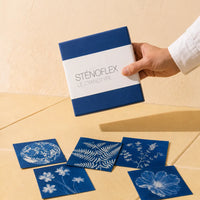
This continuity also explains why the process remains as accessible today as it was in 1842, and why it is still approached with the same techniques. The Sténoflex cyanotype kit follows this original chemistry, with its two bottles of iron salts, the paper and the instructions, so that you can make your own blue prints in the tradition of Herschel and Atkins.
It is this faithfulness to a simple principle that has spanned two centuries and made cyanotype one of the oldest photographic processes still practised.
Éric Marais — Photographer, author of two books on pinhole photography (published by Pearson) and creator of the Sténoflex. He has run introductory workshops in alternative photography, from pinhole to cyanotype, from the very beginning.