

The title of first female photographer, often given to Anna Atkins, remains disputed: what is established is that she was the author of the first book illustrated with photographs, Photographs of British Algae, begun in 1843.
Anna Atkins's name almost always comes with the same formula, the first female photographer, as if the title were self-evident. Yet it describes a reality more nuanced than it seems, because everything depends on what you mean by photographer and on the date you set for the beginning of photography.
This page looks precisely at this question of status: not Anna Atkins's life nor her book as such, but what the expression covers and how much of it actually holds up.
It extends the fuller portrait of the botanist found in the article on Anna Atkins and cyanotype, and forms part of the wider history of cyanotype. If the blue process is still unfamiliar to you, the complete guide to cyanotype lays the groundwork.
What Anna Atkins undeniably achieved
One fact is hardly open to debate. Anna Atkins applied cyanotype, which John Herschel had only just invented in 1842, to botany from the following year, and she gathered her plates of algae in a work entitled Photographs of British Algae: Cyanotype Impressions.
This book is very often cited as the first book illustrated with photographs, distributed in part among her scientific correspondents. The Royal Botanic Garden Edinburgh states that it appeared in three volumes, published in parts between 1843 and 1853.
If she chose algae, it was because, as a naturalist, she sought to represent her specimens accurately, and their fine, transparent and branched forms resisted drawing, whereas contact cyanotype recorded them faithfully.
It is this status that is the most solid and the most thoroughly documented. Photographic images already existed before her, but bringing together a body of images obtained by a photographic process in a book was a new undertaking, and it was a woman who carried it out.
What makes this first place defensible lies in the coherence of the object rather than in simple precedence of date.
Anna Atkins did not merely slip a few prints into a book that was otherwise engraved or lithographed; she conceived a whole in which every plate is a cyanotype image and the text itself is handwritten and printed by contact, so that the entire volume comes from the same photographic technique.
It is this unity of process, page after page, that leads historians to say it is the first book illustrated entirely with photographs, and not a book decorated with photographs among other techniques.

Anna Atkins, Ulva lactuca, c. 1853, cyanotype. The Metropolitan Museum of Art, 2005.100.557 (142). Public domain. Credit: The Metropolitan Museum of Art · Gilman Collection.
Why the title of first female photographer calls for caution
The difficulty lies in the word photographer, which has no single definition. Photography was born around 1839, with the daguerreotype and the first paper processes, and several women handled a camera or made images in those very first years, sometimes without leaving a lasting trace or a name attached to their attempts.
The archives of this first decade are patchy, and many prints have disappeared or circulated unsigned, so the idea of a very first one depends largely on what has survived and on what people took the trouble to keep.
Depending on whether you count the first woman to publish a book of photographs, the first to expose a plant on a sensitive support or the first to hold a camera, the answer changes.
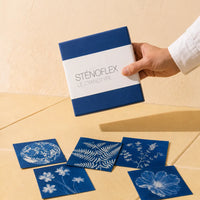
Anna Atkins, moreover, worked by contact, with no lens and no camera, simply laying her dried algae on a sensitised paper that she exposed to the sun, which sets her practice apart from the idea people spontaneously have of a photographer in the usual sense. To try the process, the Sténoflex cyanotype kit brings together the two iron salts, watercolour paper and pipettes.
The expression first female photographer is therefore less an established fact than a convenient shorthand, true in a precise sense, debatable in absolute terms. The most cautious formula, and the one historians generally adopt, presents her as the author of the first book illustrated with photographs, which remains a considerable title without attributing anything unverifiable to her.

Anna Atkins, Polysiphonia violacea, c. 1853, cyanotype. The Metropolitan Museum of Art, 2005.100.557 (12). Public domain.
A pioneering figure beyond the title
The exact status ultimately matters less than what it says about an era. Anna Atkins (1799–1871) holds a rare place in the science and imagery of her time, at a period when women had little access to published scholarly work, and her work links botany, print and a nascent photographic process more clearly than ever before.
That is no doubt her deeper singularity, more than the race for first place. That other women held a camera before her takes nothing away from the significance of her book, which remains a milestone still cited nearly two centuries later, and which the history of cyanotype places at the very start of the adventure of blue.
Taking away the absolute title of first female photographer therefore diminishes her in no way; it simply does justice to a reality richer and less clear-cut than the established formula.
Éric Marais — Photographer, author of two books on pinhole photography (published by Pearson) and creator of the Sténoflex. He has run introductory workshops in alternative photography, from pinhole to cyanotype, from the very beginning.