

A book made up entirely of blue images, without a single photograph in the sense we understand it today, and yet often cited as the first book illustrated with photographs. Such is the singular status of Photographs of British Algae: Cyanotype Impressions, which Anna Atkins began producing in 1843, barely a few months after John Herschel had developed cyanotype.
This page focuses on the book itself, its content and its significance, rather than on the life of its creator, which is told in the article on Anna Atkins and cyanotype. To put the blue process she used in context, the step-by-step guide to cyanotype recaps its principle, and the history of cyanotype traces the wider thread.
A book made of cyanotypes, not of printing
What sets the work apart is the way it was made. Each plate is a cyanotype produced by hand, without engraving or letterpress, and even the text, captions and titles were obtained by this process, handwritten on a translucent sheet laid on the sensitive paper and then exposed in the sun. The book is therefore blue from cover to cover, images and words merged in the same iron chemistry.
Anna Atkins worked by contact, laying the dried seaweed directly on the sheet prepared with the two iron salts, exactly as a botanical cyanotype is made today. The seaweed blocks the light where it lies, the rest of the sheet turns Prussian blue under ultraviolet light, and what remains is a precise white silhouette on a blue background, the exact negative of the specimen.

Text and seaweed alike are printed by contact: the book is blue from cover to cover.
Algae and nothing but algae
The subject of the book is entirely botanical, and more precisely phycological. Atkins recorded the algae of the British coasts, a group that was then difficult to represent by drawing because their forms are so fine, transparent and branched. Contact cyanotype solved this problem at a stroke, because it records the lacework of a frond or the fineness of a filament with a faithfulness that the draughtsman's hand struggled to achieve.
The work did not appear all at once. Atkins issued it in instalments from 1843 and went on adding to it for about ten years, completing her plates as she collected new specimens. The print run remained very small, only a few copies, each assembled image by image, which explains the rarity of the volumes held today in major collections.

Anna Atkins, Laminaria saccharina, c. 1853, cyanotype from Photographs of British Algae. The Metropolitan Museum of Art, 2005.100.557 (11). Public domain. Credit: The Metropolitan Museum of Art · Gilman Collection.
Why it is cited as the first book of photographs
The claim deserves to be made with care, because the book is generally presented as the first book illustrated with photographs rather than as a settled fact. What distinguishes it is that the image is obtained through the action of light on a sensitive support, not through a traditional engraving process, and that it forms the very content of the work rather than an added ornament.
Other photographic works were circulating in the same period, and the notion of “first” depends on what you are willing to call a book and a photograph, as the question of whether Atkins was also the first female photographer shows. Atkins's cyanotype is a photogram, an imprint of light made without a camera, which takes nothing away from its photographic nature in the chemical sense of the term. It is this precedence, in a bound and distributed object, that underpins its reputation.

Anna Atkins, Photographs of British Algae: Cyanotype Impressions, introduction page, c. 1853, cyanotype. The Metropolitan Museum of Art, 2005.100.557 (5). Public domain.
What the work leaves behind
The book's significance reaches far beyond botany. In it, Atkins showed that a technical copying process, designed by Herschel to reproduce notes, could become a precise tool for scientific recording and an object in its own right, where the beauty of the blue serves the accuracy of the record. Cyanotype found here one of its first fully realised uses, long before its long career in architects' plans.
The work also remains a reference for anyone working with plants in cyanotype today, because it set out a grammar that still holds, that of direct contact, the well-dried specimen and the crisp silhouette on a blue background, which you find in every contemporary cyanotype herbarium. Nearly two centuries later, Atkins's technique is still the same as the one practised in the workshop.
Making a plate today in the spirit of Photographs of British Algae requires nothing more than the original process: two iron salts, sunshine and a plant laid on the paper.
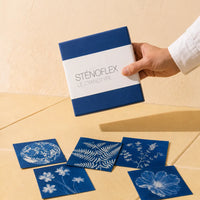
The Sténoflex cyanotype kit brings together the potassium ferricyanide, the ferric ammonium citrate and the paper needed for this kind of botanical print, so you can recreate the same blue as Atkins's algae. Potassium ferricyanide has low toxicity at the amounts used in the process, but it can release cyanide on contact with an acid, or under UV light when in solution. Handle the solutions with gloves, in a well-ventilated room.

The same technique as in the 19th century: a well-dried specimen laid on the sensitive paper, then the sun.
Header image: title page of Photographs of British Algae: Cyanotype Impressions, Anna Atkins (1843). The Metropolitan Museum of Art, public domain.
Éric Marais — Photographer, author of two books on pinhole photography (published by Pearson) and creator of the Sténoflex. He has run introductory workshops in alternative photography, from pinhole to cyanotype, from the very beginning.