

John Herschel, an English astronomer and chemist, invented cyanotype in 1842 to copy his notes and calculations, by combining two iron salts that turn Prussian blue in the light. Cyanotype is often presented as an artist's process, and people forget that it owes its existence to an English scientist who was above all looking for a convenient way to keep a record of his calculations.
John Herschel developed this blue in 1842, almost on the margins of his research on light, and it is this scientific origin that explains so much about the character of the process.
An astronomer fascinated by light
John Herschel was first and foremost an astronomer, the son of a family already famous for its work on the heavens, and a mind as fascinated by chemistry and optics as by the stars. In the early nineteenth century, he observed celestial bodies, mapped the sky of the southern hemisphere and took a close interest in the nature of light and its action on substances. It was this curiosity about the reactions caused by radiation that led him, by a long detour, to iron salts.
We also owe him a vocabulary that early photography would go on to adopt, since he helped establish the use of the words photography, negative and positive. Herschel belonged to that generation of scientists for whom a chemical discovery was only of interest if it served to observe, to measure or to preserve. Cyanotype was born in this frame of mind, as a tool before it was an art.
Herschel also gave photography its fixer. As early as 1819, he observed that hyposulphite of soda, our sodium thiosulphate, dissolves silver salts, and in 1839 he proposed it for making images stable in light.
Photographic fixers still rely on this principle, as you can see when developing a pinhole photo. Besides cyanotype, we therefore owe Herschel sodium thiosulphate fixer and part of the photographic vocabulary: photography, negative and positive.
Copying notes rather than making images
Herschel's first intention was not to produce photographs in the sense we understand them. He was looking for a simple way to reproduce his own documents, sketches and calculations, without copying them out by hand.
The process he developed meets exactly this need, because all you have to do is lay a translucent sheet on a sensitised paper, expose the whole thing to the sun, then rinse it in water to obtain a faithful copy.
This purpose explains cyanotype's very particular look: pale lines on a plain blue background, perfectly legible for a line drawing or handwriting. Where light reaches the paper, the blue forms; where the drawing blocks it, the paper stays pale.
This is the very principle of contact printing, and it is also why the process was first used to duplicate pages rather than to compose images. Chemically, this reaction relies on two iron salts that turn Prussian blue under ultraviolet light.

The drawing blocks the light: the copy shows pale lines on a plain blue background.
From the laboratory to the world of engineers
What Herschel had designed for his personal use was to enjoy a second life, far longer and far broader, in the technical world. Over the decades, the process became the preferred means of reproducing architects' and engineers' plans, under the name blueprint, those famous plans with white lines on a blue background that were long associated with construction and industry.
The word even came to mean, in everyday usage, any detailed plan or master scheme, proof of the lasting success of the invention. For more than a century, copying a plan meant making a cyanotype of it, because no other method was as economical for reproducing a large format identically.
This lineage between Herschel's technique and technical copying can be found in the distinction between cyanography and cyanotype, where the same process bears two names depending on whether it is used to reproduce or to create.

Anonymous, design for a car body (Ontwerp voor een auto), c. 1920-1930, cyanotype. Rijksmuseum, Amsterdam, RP-F-2018-33-2. Public domain.
Why his name remains attached to the process
If Herschel's name is remembered today, it is because he really was the author of cyanotype's chemistry, the one who identified and brought together the light-sensitive iron salts that make it so distinctive. It was also he who coined the term, from the Greek, combining the root for dark blue with the root for impression.
Credit must nonetheless be kept in proportion, because Herschel did not seek to make his invention an artistic medium. That intuition would come from elsewhere, notably from the botanist Anna Atkins, who in the years that followed applied the process to recording plants and produced an entire book of images from it.
But the founding act, the formula and the name are his, and it is on that basis that he is generally regarded as the inventor of cyanotype.

John F. W. Herschel, first page of On the Action of the Rays of the Solar Spectrum on Vegetable Colours, and on Some New Photographic Processes, 1842, p. 181. Philosophical Transactions of the Royal Society of London, via JSTOR and Internet Archive. Public domain. Credit: Royal Society of London · scan JSTOR / Internet Archive.
A legacy that is still alive
The process practised by amateurs today is strikingly similar to that of 1842, as can be seen in the workshop at every session:
- the salts have not changed;
- the sun is still the light source;
- tap water is still enough to reveal the image.
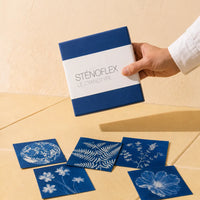
Herschel would probably never have imagined that his copying method would one day be used to print ferns, portraits or designs on fabric, and yet the same chemistry is at work. To try the process, the Sténoflex cyanotype kit brings together the two iron salts, watercolour paper and pipettes.
Understanding where cyanotype comes from changes the way you practise it, because you appreciate better the simplicity of a technique nearly two centuries old. The history of cyanotype places Herschel's invention in a broader chronology, from the first engineers' plans to contemporary uses.

Potassium ferricyanide and ferric ammonium citrate: the two iron salts in the Sténoflex cyanotype kit are those of Herschel's recipe.
Éric Marais — Photographer, author of two books on pinhole photography (published by Pearson) and creator of the Sténoflex. He has run introductory workshops in alternative photography, from pinhole to cyanotype, from the very beginning.