


The same iron-and-sunlight process goes by several names, and the confusion between cyanography and cyanotype comes up often, in workshops as well as in online searches. Both words revolve around the same blue, but they did not catch on in the same way, and knowing which one to use avoids a good many misunderstandings.
The short answer fits in one sentence: cyanotype and cyanography refer to the same photographic process, the one that produces a blue image by contact in the sun. Here we focus on the words themselves. The basics of the process, from the solution to the rinse, are gathered in our cyanotype guide.
What the word cyanotype means
The term comes from Greek: from kuanos, meaning a dark blue, the same one found in cyan, and from tupos, meaning an impression or mark. The word therefore literally means blue impression, which describes the technique rather well: an image obtained through direct contact between a surface and light.
This is the name used by the English astronomer John Herschel when he described the process in 1842. The suffix -type, shared with the daguerreotype and the calotype from the early days of photography, anchors the word in the photographic vocabulary of the time. Cyanotype is today the standard term, the one used in manuals, in museums and in everyday practice.
Where the word cyanography comes from
Cyanography is built on the same root, kuanos, blue, to which graphein, to write or to draw, is added this time. The word therefore means writing in blue or blue drawing, a construction very close to that of photography, literally writing with light.
This term has circulated in French (cyanographie) and in other languages as a synonym for cyanotype, sometimes to refer more specifically to the reproduction of documents and plans in blue.
It remains correct, and you come across it in old or technical texts, but its use has declined markedly in favour of cyanotype. In workshops, you mainly hear cyanography from those who came across the process through its industrial side, the printing of plans.
The link with the architects' blueprint
This is where the two words really meet. At the end of the nineteenth century, the process enjoyed a long technical career reproducing architectural and engineering drawings cheaply and without copying them by hand. These sheets came out white on a blue background, which earned them the English name blueprint, the blue plan.
According to a study published by the American Institute for Conservation, in the 1880s cyanotype became the main process for copying plans in design offices, and remained so until the mid-1950s.
In French, these reproductions were long called cyanographies or tirages au bleu (blue prints), and it was this trade of copying plans that fixed the word in certain circles.
The term blueprint has in fact outlived the technique itself: it is still used figuratively to mean a master plan or an overall scheme, even though no one prints plans with ferricyanide any more. Potassium ferricyanide has low toxicity at the amounts used in the process, but it can release cyanide on contact with an acid, or under UV light when in solution.
Yet the process remains exactly the same as in artistic use: two iron salts made sensitive to ultraviolet light, exposure in the sun, then a rinse in water.
Whether you are reproducing an architect's plan or laying a fern on the paper for a photogram, the chemistry does not change; only the use differs. The materials are therefore identical too: two iron salts, water, a suitable paper and the sun.

Isak Gustaf Clason, plan of the outer doors of the Hallwyl Palace, 1896, blueprint. Hallwyl Museum, Stockholm, HWY LXIV:III:B.b.b.96. Photograph: Jenny Bergensten. Public domain.
Which term to use today
To talk about the artistic process and studio practice, cyanotype is the right word, the most widespread and the most widely understood. It is the one that suppliers, books and other practitioners expect, and it is the one we use throughout this journal.
Cyanography is not a mistake, simply a rarer synonym, coloured by its history of reproducing plans. If you come across it in an old text or from a printer's pen, you can read it as an equivalent of cyanotype without looking for any hidden technical nuance.
As for blueprint, it is the English name for the same thing in its document-copying use, which has become an image far more than a photographic term.
| Term | Roots | Literal meaning | Use today |
|---|---|---|---|
| Cyanotype | kuanos (dark blue) and tupos (impression) | Blue impression | Standard term: manuals, museums, everyday practice |
| Cyanography | kuanos (blue) and graphein (to write, to draw) | Writing in blue, drawing in blue | Rarer synonym, in old or technical texts |
| Blueprint | English name | Blue plan | Copying plans; figuratively, a master plan |
Trade names add to the confusion too. Sunprint, or sun paper, is most often a pre-coated cyanotype paper, ready to expose: the process is the same, under another name.
One last distinction is worth making to finish with these vocabulary mix-ups. The word cyan, which names the blue-green of printing inks, shares the same Greek root but does not refer to the process: it is a colour, not a technique. The blue of cyanotype is Prussian blue, a pigment born of the reaction of iron to light.
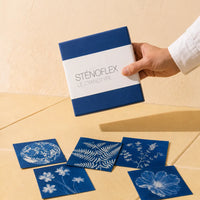
Once the words are clear, it is the practice that counts. Our guide to the definition of cyanotype goes over in detail what the process involves, and the Sténoflex cyanotype kit lets you move from vocabulary to your first blue image.
Éric Marais — Photographer, author of two books on pinhole photography (published by Pearson) and creator of the Sténoflex. He has run introductory workshops in alternative photography, from pinhole to cyanotype, from the very beginning.