

To buy a cyanotype kit, turn to a shop specialising in alternative photography, an art supplies shop, an online platform or the maker directly, checking each time what the box really contains, how fresh the chemicals are and what the instructions cover.
Once the urge to make your first blue prints has taken hold, the very practical question arises of where to get the materials. Cyanotype is not a mass-market hobby; you will not find it in the stationery aisle of the supermarket, and it is precisely because the places that sell it are less obvious that it is worth knowing where to look and what each route really offers you.
This page goes over the places where you can buy a cyanotype kit, from specialist shops to art supplies shops, from online retail to the maker itself, and points out which one suits your situation.
If you are still unsure about the process before ordering, the complete guide to cyanotype puts it all in context, and the question of which cyanotype kit to choose is dealt with separately, because finding where to buy and deciding what to buy are two distinct steps.
Shops specialising in alternative photography
The first route is through shops dedicated to historical and alternative photography, most often online, sometimes backed by a physical studio. There you find cyanotype alongside carbon printing, gum printing and palladium, and the sellers genuinely know the processes they offer.
It is the most reliable place to look when you want reagents that keep well and advice that goes beyond a marketing sheet.
The downside is that you often find products designed for practitioners who are already experienced, sold separately rather than as a guided set, which assumes you know how to measure out the chemicals and already have your own paper. For a very first attempt, this route calls for a little background knowledge, but it becomes invaluable as soon as you want to refine your practice.
Art supplies and craft shops
A second possible place is art supplies shops and some of the large craft retail chains, in store or on their websites. The advantage is immediate: you can sometimes see the product, leave with it, and combine it with watercolour paper bought from the same aisle.
The range remains uneven from one shop to another, however, since cyanotype is not a permanent section, and the advice is geared more towards drawing or painting than towards the chemistry of iron salts.
You will easily find good paper that stands up to rinsing, but the kit itself is rarer there and the seller will seldom be able to guide you on the colour change or the exposure. It is a good starting point when you are already comfortable with the process and want to add to your equipment on the spot.
General online retail
The large online retail platforms also offer cyanotype kits, sometimes many of them, and they are often the first reflex because buying there is so quick and easy. Availability is wide and delivery fast, which is appealing for a gift or for trying the process without waiting.
The trade-off calls for vigilance. Where the product comes from is not always clear, how fresh the reagents are even less so, and it is easy to compare two boxes on price alone without lining up what they really contain, when a kit sold as complete may well supply only the chemicals.
The instructions, often the most overlooked criterion, nonetheless make the difference between a successful first print and a disappointment, and they are not all equal. You still have to read the guidance that comes with it, without being either alarmed or lulled into a false sense of security.
This route is handy in a pinch, provided you look closely at who is selling and what is really in the box. A cyanotype kit calls for a few precautions: the salts are handled with gloves, in a well-ventilated room, and must never come into contact with an acid.
Buying directly from the maker
That leaves the shortest route: buying directly from the maker, who packages and ships their own reagents. You gain on two counts: fresher chemicals, which travel less, and someone to deal with who actually practises the process.
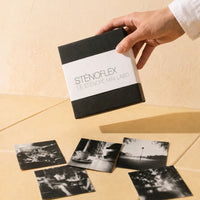
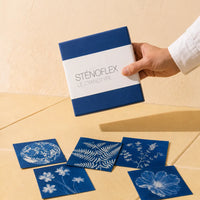
The Sténoflex cyanotype kit is sold this way, directly by Sténoflex; it is made in France and comes with a bottle of potassium ferricyanide, a bottle of ferric ammonium citrate, ten sheets of watercolour paper, two pipettes and instructions. Potassium ferricyanide has low toxicity at the amounts used in the process, but it can release cyanide on contact with an acid, or under UV light when in solution.
The kit is designed for getting started, with what you need to understand the process, make mistakes on a few sheets and succeed with your first prints in the sun, without a darkroom.
It is one good choice among others: practitioners who produce in large runs will find its limits in volume, and those who already have their favourite paper will pay for sheets they have no use for, but as a reliable way in it is the most direct route. A kit also works on fabric, since the same iron salts sensitise cotton or linen just as well as paper.

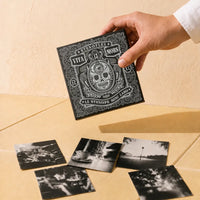
The Sténoflex cyanotype kit shown on a light background, with its contents. Photograph from the Sténoflex image library. Credit: Sténoflex image library.
Which route to choose for your needs
To get started, the kit to go for is a complete set, with fresh chemicals, paper that holds up and clear instructions, which saves you hunting for each item. In workshops, the answer always comes back to the same question: where are you at, and what do you expect from this first purchase? If you are new to cyanotype and want a complete set without having to track down each item, the maker or a specialist shop that offers good guidance spares you unpleasant surprises over provenance and instructions. If you already practise and know what you are looking for, an art supplies shop or an alternative photography shop lets you put together your own selection.
General online retail is handy when time is short, provided you check the actual contents and the provenance.
The right place is neither the cheapest nor the fastest; it is the one that supplies fresh chemicals, paper that holds up and clear instructions, in other words the one that gives you your best chance of succeeding with your first blue print. Once that question is settled, all that remains is to decide what the kit should contain.
Éric Marais — Photographer, author of two books on pinhole photography (published by Pearson) and creator of the Sténoflex. He has run introductory workshops in alternative photography, from pinhole to cyanotype, from the very beginning.