

To get started, choose an all-in-one kit that brings together the two iron salts, paper that stands up to rinsing and instructions; if you already have your paper, the chemicals alone are enough. Two cyanotype kits sold at the same price can have almost nothing in common. One supplies the chemicals, the paper and detailed instructions, the other two bottles and nothing else. To choose well, you need to compare what each box really contains and the form in which the reagents arrive.
This page reviews the criteria that matter when you compare kits, so you can avoid the purchase that ends up gathering dust in a cupboard.
All-in-one kit or chemicals only
Two broad families of kits stand apart in what they supply and in how much of the preparation is left to you.
| Type of kit | What it contains | Preparation | Who it suits |
|---|---|---|---|
| All-in-one kit | The two iron salts, the paper, small equipment and instructions | You mix the two salts in equal parts and coat the paper yourself | Making your first cyanotype without hunting down each item |
| Chemicals only | The two iron salts, with no paper or accessories | The same, on your own watercolour paper, on fabric or on another support | Practitioners who already know which support they want to sensitise |
Without any kit, you can also buy the two salts in bulk from a chemical supplier, weigh them and dissolve them yourself following the cyanotype recipe. This route is not necessarily cheaper for a first attempt, because the reagents are often sold in laboratory pack sizes and the paper is bought separately, sometimes with several delivery charges.
What a cyanotype kit really contains
The word kit covers different realities, and the first thing to check is what the box actually contains, even before the price. A cyanotype relies on two iron salts, ferric ammonium citrate and potassium ferricyanide, which you mix in equal parts to make the light-sensitive solution.
These two reagents are the heart of any kit; everything else is organised around them. Potassium ferricyanide has low toxicity at the amounts used in the process, but it can release cyanide on contact with an acid, or under UV light when in solution.
Beyond the two salts, a kit may or may not include paper, pipettes for measuring, gloves and instructions that explain the technique.
A product sold as complete that supplies only the chemicals leaves you halfway there, because you will have to find paper that stands up to rinsing separately. The most common mistake is to compare two kits on price alone without lining up what they really contain.

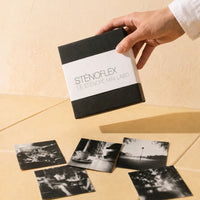
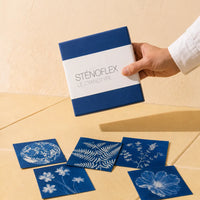
The contents of the Sténoflex cyanotype kit, photographed flat. Sténoflex image library.
Ready to use or powder to measure out
The second major dividing line is the form in which the reagents arrive. Some kits supply ready-mixed liquid solutions, ready to spread as soon as you open them; others supply the salts as a powder that you dissolve yourself before use. This detail matters more than you might think.
A ready-to-use solution saves you the first few minutes and reassures beginners who are afraid of getting the mix wrong, but once prepared it ages, whereas a powder kept dry lasts longer and lets you prepare just the amount you need, without even weighing anything when the bottle is calibrated for a given volume.
If you intend to keep practising over time, a powder to reconstitute is often the most economical and flexible choice, whereas for a one-off try the ready-mixed solution makes sense. It all depends on how often you will print.
Sunprint sun-printing papers are another format: the sheet is already sensitised, which removes the coating step.
The quantity of chemicals and paper
A kit is also judged by what it lets you produce, a point that product descriptions tend to pass over in silence. The quantity of solution determines the area you will be able to sensitise: the two 15 ml bottles in the Sténoflex kit comfortably cover the 10 sheets supplied, depending on how absorbent the paper is.
The number of sheets matters just as much, because a kit that supplies the chemicals but only two or three sheets of paper leaves you short after your first attempts, and learning cyanotype involves failures.
Around ten sheets give you the leeway to understand the colour change, adjust the exposure in the sun and keep going until your first good print. Finally, think about restocking: a kit whose chemicals or paper you can buy again will stay with you for a long time, whereas a closed box comes to an end once it is empty.
Instructions and kit safety
Three criteria that are easy to miss make a difference in practice. The origin of manufacture tells you something about the freshness of the reagents and how easy it is to restock, since chemicals packaged close to home travel less and are simpler to buy again. It is less a point of pride than a question of availability over time.
The instructions are the most overlooked criterion and one of the most useful, because cyanotype depends on a few precise steps: coating, drying away from the light, recognising the colour change and rinsing. Clear instructions make the difference between a successful first attempt and a disappointment caused by misunderstanding a step, and rinsing a cyanotype is a good example.
Gloves, ventilation and never any acid
That leaves safety. The two iron salts should be handled with care, with gloves, ventilation and the common sense not to swallow them, but a persistent myth needs correcting: potassium ferricyanide has low toxicity at the amounts used in the process, but it can release cyanide on contact with an acid, or under UV light when in solution, and the Prussian blue that forms is a pigment so stable that it is even used in medicine. A good kit comes with honest guidance on its reagents, neither alarmist nor silent, and the page on cyanotype hazards and safety sets out the facts without dramatising.
The all-in-one kit designed for beginners
The second option brings together the chemicals, the paper and small equipment in a single box, with instructions that guide you step by step. It is the most direct route for anyone who wants to make their first cyanotype without turning the preparation into a chemistry project.
The Sténoflex cyanotype kit belongs to this family, and here, in all fairness, is what it contains: a bottle of potassium ferricyanide, a bottle of ferric ammonium citrate, ten sheets of watercolour paper, two dosing pipettes and instructions. The whole kit is made in France.
A kit designed for getting started
This kit is designed for getting started: it brings together what you need to understand the process, make mistakes on a few sheets and succeed with your first prints in the sun, without a darkroom. It is one good choice among others.
Practitioners who produce in large runs will find its limits in volume, and those who already own their favourite paper will pay for sheets they have no use for. Its territory is discovery, the moment when you want a reliable way in.
When chemicals alone are enough
The third route sits in the middle: you buy only the two iron salts, with no paper or accessories, because you already have what you need to work with. It is aimed at those who have moved past the discovery stage and know which support they want to sensitise.
It is the natural option for practitioners who print on their own watercolour paper, on fabric or on one of the other cyanotype supports, and who want to renew their chemicals without paying again for paper they will not use. It avoids waste and keeps costs in line with what you actually use over time. Its only prerequisite is knowing how to choose a suitable support, which becomes second nature after a few successful prints.
Comparing two kits in practice
To compare two kits, line them up criterion by criterion rather than on price alone. Are both iron salts supplied, and for what volume of solution? Is paper included, and how many sheets? Do the chemicals arrive as a liquid or as a powder? Do the instructions explain coating, the colour change and rinsing? Can you buy the chemicals or the paper again separately?
If you are discovering cyanotype, an all-in-one kit with chemicals, paper and instructions saves you time, and that is the use the Sténoflex kit was designed for. All that remains is to know where to buy a cyanotype kit.
If you already know which paper you like, chemicals alone spare you a pile of unused sheets, and the complete list of cyanotype supplies sums up what you need to gather alongside. The right kit is the one that matches your level and what you are really going to print, whatever its price.
Éric Marais — Photographer, author of two books on pinhole photography (published by Pearson) and creator of the Sténoflex. He has run introductory workshops in alternative photography, from pinhole to cyanotype, from the very beginning.