

Cyanotype is a photographic process based on contact printing that produces a deep blue image from two iron salts made sensitive to sunlight. You lay a negative or an object on a coated paper, expose it to the sun, rinse it in clean water, and the blue appears. No darkroom, no laboratory, just light and water.
It is this simplicity that surprises people at workshops who imagined photography as a matter of cameras and chemicals. The word sounds technical, almost off-putting, yet it refers to one of the most straightforward processes to put into practice.
This page sets out a clear definition and, for each point, refers you to the article that explores it further. To place this process within the full range of techniques and creative avenues, the complete cyanotype guide is the place to start.
Where the word cyanotype comes from
The term comes from Greek, from two roots that say almost everything about the process. Kuanos means a dark, deep blue, the blue found in the name cyan and in a whole family of words around this shade. Tupos means an impression, the mark left by contact.
A cyanotype is therefore, literally, a blue impression. This etymology is not just a curiosity: it describes exactly what happens on the paper. The blue is not an ink or a dye applied afterwards, and the image does not come from a lens projecting a scene; it is born of the impression left by light wherever it was able to reach the sensitive surface.
The word was coined in the nineteenth century by the English astronomer John Herschel. According to the Bibliothèque nationale de France, he developed the process in 1842. The suffix -type, common to many early photographic processes such as the daguerreotype and the calotype, simply signals a printing technique. The family of alternative processes is rich in these -type names, each designating its own chemistry and look.
A simple definition of cyanotype
If you had to sum up cyanotype in one sentence, it would be this one: a photographic process that fixes a blue image on a surface coated with iron salts, simply by exposing it to the sun and rinsing it in water.
Three characteristics set it apart and deserve a closer look. The process works by contact, which means that you lay the thing to be reproduced, a negative or an object, directly on the paper, with no camera and no projection.
It uses ultraviolet light from the sun as its source of energy, which does away with any need for a darkroom. And it produces a single colour, Prussian blue, which is the very signature of the process.
This simplicity has a welcome practical consequence. You prepare and handle the paper in the ordinary light of a room, as a standard light bulb emits almost no ultraviolet, and you only keep out of the sun while it dries. Everything else happens outdoors, in the sun, then under the tap. It is this accessibility that often makes it people's first encounter with alternative photography.

Henry Bosse, Mouth of the St. Croix River, 1885, cyanotype. An example of a blue photographic print, here devoted to a landscape. Smithsonian American Art Museum, 1994.91.30. Public domain.
How the process works in a few words
The principle comes down to a chain of short steps, each with its own purpose. You mix two powdered iron salts dissolved in water in equal parts, ferric ammonium citrate and potassium ferricyanide, then coat the paper with this mixture and leave it to dry away from light.
Potassium ferricyanide has low toxicity at the amounts used in the process, but it can release cyanide on contact with an acid, or under UV light when in solution.
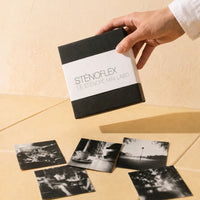
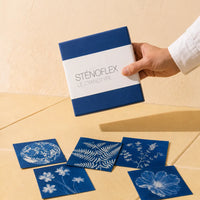
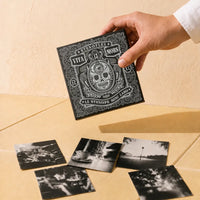
For a first try without tracking down each reagent separately, the Sténoflex cyanotype kit brings together the two iron salts, ten sheets of watercolour paper, the pipettes and instructions.
The paper sensitised in this way reacts to UV light. You lay a black-and-white negative or an opaque object on it, a leaf, a flower, a piece of lace, and expose the whole thing to the sun. Where the light strikes, a chemical reaction is set off and fixes the blue in the fibre; where the object blocks it, the paper stays blank.
A rinse in clean water then carries away the unchanged salts and reveals the image, with the blue reaching its full depth as it dries. No fixer is needed, as Cornell University Library points out in its presentation of the process.
- Mix ferric ammonium citrate and potassium ferricyanide, dissolved in water, in equal parts
- Coat the paper with this mixture, then leave it to dry away from light
- Lay a black-and-white negative or an opaque object on the paper
- Expose the whole thing to the sun
- Rinse in clean water to reveal the image
- Leave to dry: the blue then reaches its full depth
The process therefore comes down to three ingredients, two iron salts, the sun and water, with no chemical developing bath in the classic sense. The chemical reaction takes place in the fibre of the paper. The details of proportions, coating and drying belong to practice, and the cyanotype recipe goes through each measurement step by step.
Why the image is blue
The colour is not an aesthetic choice: it follows directly from the chemistry of iron. Under ultraviolet light, the iron changes state, and an intense, insoluble blue compound forms in the paper: Prussian blue. It is this compound that draws the image, wherever the light was able to act.
This blue is therefore the native colour of cyanotype, not an added tint. You can then shift it towards brown or violet with toning baths, but straight out of the rinse, without any intervention, a cyanotype is blue. Properly rinsed, a cyanotype keeps for a long time in a dry place, away from prolonged direct light and from alkaline mount board.
To understand in detail why cyanotype is blue, and exactly how this shade of Prussian blue comes about, a whole article is devoted to the question. The precise mechanics of this reaction, the two salts involved and how they are transformed, are covered in detail in our guide to cyanotype chemicals.
One point often reassures beginners, because the name of one of the reagents is worrying. Potassium ferricyanide is not free cyanide: its atoms are tightly bound to the iron, and the compound has low toxicity at the amounts used in the process, but it can release cyanide on contact with an acid, or under UV light when in solution: it must therefore never come into contact with an acid.
The reagents should nonetheless be handled with care, with gloves and in a well-ventilated room, without being alarmist.
Cyanotype in the family of alternative processes
Cyanotype belongs to what are known as alternative processes, or historical processes, a group of photographic techniques that predate the silver-based photographic industry and then digital, and which practitioners keep alive today for the pleasure of the craft and the materials. Pinhole photography, gum bichromate, palladium and Van Dyke brown are among them, each with its own chemistry and texture.
Within this family, cyanotype holds a special place for its simplicity and its closeness to the photogram. Because the image forms by contact and not by projection, laying an object on the paper is enough to print its silhouette, with no negative at all.
This kinship with the imprint is what tied the process to botany and nature very early on, from the first cyanotypes of algae made in the 1840s.
The process also shares a technical trait with other contact prints: it uses ultraviolet light rather than an enlarger, which makes it dependent on the sun or a UV source. This constraint is also its freedom, since it moves the studio outdoors and makes the weather one of the parameters of the image.
The two meanings of cyanotype, and cyanography
The term sometimes causes confusion, because you also come across the word cyanography, and the word cyanotype itself covers two closely related things. It refers both to the process, that is, the printing technique, and to the object produced, the print itself. So you say that you practise cyanotype, and that a cyanotype hangs on the wall.
Cyanography, for its part, refers rather to the technical, reproducible use of the process, notably copying plans and documents, whereas the word cyanotype remains tied to its photographic and artistic dimension.
The difference between a cyanotype and a blueprint therefore lies in the use, not the process: a blueprint is a cyanotype used to copy architects' and engineers' plans, in white lines on a blue background. The distinction is not always clear-cut in everyday usage.
| Term | What it refers to |
|---|---|
| Cyanotype, the process | The printing technique (“practising cyanotype”) |
| Cyanotype, the object | The resulting print (“a cyanotype hanging on the wall”) |
| Cyanography | The technical, reproducible use, such as copying plans and documents |
| Blueprint | A cyanotype used to copy plans, in white lines on a blue background |
Remembering the word's two meanings avoids a good many misunderstandings. When you talk about getting your cyanotype right, you mean the print; when you talk about learning cyanotype, you mean the process. One Greek root, a blue impression, for the technique and for the image it produces alike.
Where to start with cyanotype
Once the definition is clear, the surest way to understand the process is still to try it once. It needs very little, two iron salts, a suitable paper, water and a patch of sunshine, and the first image is often enough to fix in your hands what no explanation can fully replace.
From there, each article devoted to cyanotype explores a specific point, from choosing the paper to exposure, to turn this definition into know-how.
Éric Marais — Photographer, author of two books on pinhole photography (published by Pearson) and creator of the Sténoflex. He has run introductory workshops in alternative photography, from pinhole to cyanotype, from the very beginning.