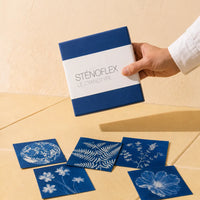


The blue of cyanotype is striking in its depth, a dark, slightly nocturnal blue that looks like no printing dye. Many people think it is added, that it is a colourant laid on the paper. Yet the colour is never applied: it forms in the fibre at the moment the light acts, and its name already says a great deal: it is Prussian blue.
Understanding why the print turns this precise blue, and not green or brown, means grasping what sets this process apart from other alternative processes.
The colour is the chemical signature of cyanotype, so much so that the word itself comes from the Greek kuanos, that dark blue. To place this colour within the process as a whole, from the sensitive coating to the finished print, the cyanotype guide serves as a common thread.
Prussian blue is a pigment, not a dye
The compound that colours a cyanotype has a chemist's name, ferric ferrocyanide, and a much older studio name, Prussian blue. It is a pigment, that is, a solid, insoluble coloured substance, unlike a dye, which dissolves and soaks in. This distinction is not a detail: it explains almost everything about how a print behaves.
A dye colours by penetrating the fibre, but it can wash out, fade or migrate. A pigment stays where it formed, clinging to the material without dissolving in it. Prussian blue belongs to this second family, and that is why you can rinse a cyanotype at length in clean water without washing out the blue, even though the rinse carries away everything else.
This pigment has a history that long predates photography. It appeared in Berlin at the beginning of the eighteenth century, the first stable synthetic blue in the history of colour, and it immediately found its way into painters' studios, where it replaced rare and costly blues. When cyanotype was born, more than a century later, it simply produced this old pigment by a new route, that of light.

The blue forms in the fibres of the surface; this close-up shows the texture of a dry print.
Why this colour and not another
The blue comes from the meeting of two iron salts that are mixed just before use, ferric ammonium citrate and potassium ferricyanide. As long as they stay in the shade, nothing happens and the paper keeps its rather dull yellow-green tint.
It is ultraviolet light that triggers the colour. Potassium ferricyanide has low toxicity at the amounts used in the process, but it can release cyanide on contact with an acid, or under UV light when in solution.
Under the effect of the sun's UV light, the iron changes state. The iron in oxidation state III is reduced to iron II, which then reacts with the ferricyanide to form Prussian blue. The colour is therefore not laid on the paper: it builds up within the fibre, molecule by molecule, wherever the rays have struck.
This intense blue comes from the very structure of the pigment. In Prussian blue, iron exists in two oxidation states at once, and it is this proximity of two forms of iron that absorbs red and orange light and sends back only the deep blue that the eye perceives.
No other shade is possible with these two particular salts: the blue is written into the chemistry of the process, not chosen by the practitioner. The complete mechanism, from the sensitive iron to the revealed image, is covered in detail on the page explaining how cyanotype works.
An insoluble blue that holds the image
The insolubility of Prussian blue is not just a curiosity: it is what makes the image possible. During exposure, the pigment forms where the light passes through and nowhere else. Where a dark negative or an opaque object has blocked it, the iron salts remain intact and soluble.
Rinsing in clean water then plays on this contrast. It carries away the unchanged salts, which tint the water yellow and leave the paper white in the protected areas, and it leaves in place the insoluble Prussian blue that draws the image. Without this difference in solubility between the pigment formed and the starting salts, there would be no drawing, just a uniformly tinted sheet.
- In the areas protected from light, the salts stay soluble and wash away in the rinse.
- In the exposed areas, Prussian blue is insoluble and stays in place.
The blue also deepens after rinsing, as it dries. An image that looks pale coming out of the water often darkens in the hours that follow, as the pigment oxidises and reaches its full density. A print that stays washed out for good usually comes down to an earlier cause: the exposure or the paper.
A stable pigment that is even used in medicine
The stability of Prussian blue explains why a cyanotype that has been properly rinsed and dried comes through the years without changing colour. The pigment resists water, does not dissolve, and has little to fear except prolonged direct light and moisture, against which any image needs protecting anyway.
This stability even goes beyond photography. Prussian blue is so inert and so chemically unavailable that it is used in medicine, in a purified form, as an antidote in certain cases of heavy metal poisoning. The pigment that colours a studio print thus belongs to a family of compounds known for their durability, which is reassuring for the longevity of a work.
Ferric ferrocyanide should not be confused with the free ferricyanide you handle at the start, either. The word may be worrying, but once the pigment has formed, the iron holds the cyano groups tightly and the compound remains very stable. The starting reagents should nonetheless be handled with care, with gloves and in a well-ventilated room.
It is therefore this old, stable and insoluble pigment that gives the process its visual identity. If you want to get your hands dirty and watch this blue form in the fibre of the paper, the Sténoflex cyanotype kit brings together the two iron salts and suitable paper for a first print.
Éric Marais — Photographer, author of two books on pinhole photography (published by Pearson) and creator of the Sténoflex. He has run introductory workshops in alternative photography, from pinhole to cyanotype, from the very beginning.