

The dark chamber of a pinhole camera is the opaque box that protects the light-sensitive paper or film. Light must enter it through the intended hole and then reach the sensitive surface at the back, without mixing with any leak coming through the walls.
To prepare this box, three things matter:
- closed joints that do not let daylight through;
- an inside painted matt black to limit reflections;
- a shutter that covers the hole between exposures.
An ordinary box can do the job if you take care over these points.
This dark chamber belongs to the camera. Here it does not mean the room where you develop the photograph, even though in French the two share the same name. The camera obscura’s principle of projection explains how the image forms; the paper or film at the back is what records it.
The opaque box that protects the sensitive paper
A dark chamber is a closed, opaque enclosure, completely dark inside, with a single small hole. Light from outside enters through this hole and projects an upside-down image of the outside scene onto the opposite wall.
It is upside down because light rays travel in straight lines and cross as they pass through the hole: what comes from the top strikes the bottom of the wall, and vice versa.
The expression translates the Latin camera obscura, which literally means dark chamber. Originally, the term referred to a room that an observer entered to see, on the back wall, the landscape outside projected through a hole in the shutter.
The photographic pinhole camera uses exactly this principle, scaled down to the size of a box. A dark enclosure, a single hole, an image at the back: the one difference lies in what you place on that back wall, and that is what separates the simple dark chamber from the photographic camera.
Why a pinhole camera is a dark chamber
A pinhole camera does not use the principle of the dark chamber, it is a dark chamber: the box with a hole that you handle matches the definition point for point, a closed enclosure that is black inside, with a single opening through which light enters.
What tips this dark chamber over into photography is the addition of a light-sensitive surface at the back of the box, paper or film, so that the image is no longer just looked at, as on a wall, but recorded, having become a photograph that can then be developed. The photo paper used in pinhole photography has very low sensitivity, from 3 to 6 ISO.
The hole plays the role of the lens and forms the image through its smallness alone. The dark chamber, for its part, is the shell that makes the image possible, by making sure that light reaches the paper through the hole and nowhere else.

Dark chamber or darkroom: the two meanings of the French term
This is where the most common confusion arises, because in French chambre noire refers to two quite distinct things depending on the context.
The first meaning is the one we have just seen: the camera itself, the dark box with a hole that is used to take the photo. As soon as you hold a pinhole camera, you are already holding a dark chamber in your hands.
The second meaning is the developing room, the lab where the paper is handled away from daylight to bring out the image, the dimly lit room, often lit by a red lamp, that springs to mind when you hear the expression, and which English calls the darkroom.

Light-tightness makes all the difference
A dark chamber only deserves its name if it is truly dark inside, and this is the strictest requirement of the process, because the slightest trickle of stray light, through a badly closed joint or a corner that lets daylight in, adds itself to the image and fogs it.
The remedy comes down to a few simple steps: edges lined with black tape, a matt interior to avoid reflections and a shutter that covers the hole between exposures, because light-tightness is the very condition for a clean image to form. A pinhole mini-lab supplied ready to use takes care of this light-tightness in advance, shutter included.
The same requirement applies to the developing room, with one nuance. Black and white paper is not very sensitive to red light, which allows safelight lighting, a red lamp kept at a good distance, under which you can see what you are doing without fogging the sheet.
To develop a pinhole photo, a bathroom with its daylight leaks blocked is therefore enough as a darkroom. Once the session is over, you still need to store and dispose of the photo baths: ADEME, the French environment agency, asks for used baths to be taken to a recycling centre.
The dark chamber before photography
The dark chamber is far older than photography: the phenomenon of an image projected through a hole into a dark room was observed and described centuries before anyone knew how to fix that image. According to the Swiss Camera Museum (in French), Aristotle noted it as early as the 4th century BC, without explaining it.
Leonardo da Vinci gave a rational explanation of the phenomenon at the end of the 15th century, and Giovanni Battista della Porta gathered what was known about it in 1558 in Magiae Naturalis. In the 16th and 17th centuries, the camera obscura became a drawing instrument for painters, before Nicéphore Niépce used it in 1827 to fix the oldest surviving photograph.
The dark chamber is the concept, observed for a very long time, and the photographic pinhole camera is its application, the one that finally records the image.

Preparing a light-tight box for taking pictures
Building a dark chamber yourself is no great feat, since an opaque, well-closed box already does the job. To make one, paint the inside matt black, line the edges with black tape, make a tiny hole in one wall and cover it with a shutter between exposures.
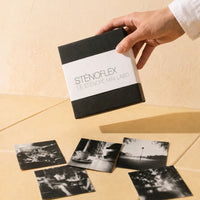
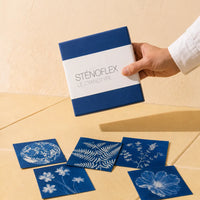
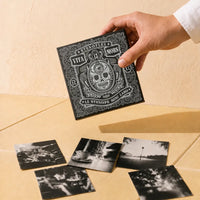
If you would rather start from an enclosure that is already light-tight and calibrated, the Sténoflex kit provides a pinhole dark chamber with its shutter, its paper and its chemicals, with the light-tightness taken care of in advance, so that all that is left is to watch the image form. It is often on seeing this first image appear that you really grasp what the term dark chamber covers.
Éric Marais — Photographer, author of two books on pinhole photography (published by Pearson) and creator of the Sténoflex. He has run introductory workshops in pinhole photography and analogue developing from the very beginning.