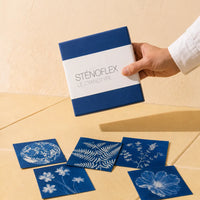


Sunprint and sun paper are, more often than not, ready-to-use cyanotype: a paper already coated with iron salts, which you expose to the sun and then rinse in water to get white silhouettes on a blue background. Solarfast, on the other hand, is not cyanotype but a photoreactive dye, whose colour appears and becomes permanent under ultraviolet light, before a wash removes the undeveloped dye.
The difference therefore lies in the chemistry and in the freedom it leaves you. The cyanotype you prepare yourself, presented in the cyanotype guide, is the same process as Sunprint, but you apply it to the paper or fabric of your choice.
Sunprint, a ready-prepared cyanotype
Sunprint paper was developed in 1975 by educators at the Lawrence Hall of Science, the science centre of the University of California, Berkeley. Their idea: to offer a paper already impregnated with iron salts, to remove the coating step and turn it into a teaching tool.
The technique is the same as with a classic cyanotype. You place objects on the sheet, expose it to the sun, then rinse it in water. The exposed areas turn blue, while those the objects protected stay pale.
Museum activity sheets sum it up simply: sun print paper is coated with chemicals that are sensitive to ultraviolet light, and these sun prints are a form of cyanotype.
Sun paper, one name for two things
In French, papier solaire (sun paper) most often refers to this same pre-coated cyanotype paper, sold in opaque pouches. Because it is already sensitive, it is kept away from light until use, and a pouch opened in broad daylight quickly fogs blue.
The same term is sometimes used for an entirely different activity. On plain coloured paper left in the sun for several hours, the exposed areas fade while those hidden by the objects keep their colour. There is no photographic chemistry involved: it is simply the paper fading under ultraviolet light.
Solarfast, a different chemistry
Solarfast belongs to a different family, that of photoreactive dyes. They are applied with a brush or a sponge, then the colour develops and becomes permanent in sunlight.
These dyes come in several colours and are mainly used on natural fibres, cotton, linen or silk, as well as on wood or rag paper. They are fixed without heat, and a dedicated wash product removes the undeveloped dye.
With an object placed on top, they also produce a photogram, and you can contact-print a negative. The image principle is therefore similar, but there are neither iron salts nor Prussian blue involved.

The step that pre-coated paper removes: brushing on the cyanotype solution, out of the sun.
The differences at a glance
- Chemistry: iron salts for Sunprint and home-made cyanotype, a photoreactive dye for Solarfast.
- Colour: Prussian blue for the first two, a choice of several colours for Solarfast.
- Preparation: none for pre-coated paper, a coating to apply yourself for cyanotype and for the dye.
- Development: a rinse in water for cyanotype in all its forms, a dedicated wash for Solarfast.
- Supports: the size of paper sold for Sunprint, the paper or fabric of your choice for home-made cyanotype.

On the left, an unbranded pre-coated sun paper; on the right, a watercolour paper sensitised with a brush, still yellow-green.
Which one to choose for your project
For a first discovery with young children, pre-coated paper gets straight to the point: you place, you expose, you rinse, with no preparation at all.
For a carefully made print, a photographic negative or a large format, the cyanotype you coat yourself lets you choose the paper and the size. For a textile in several colours, photoreactive dyes meet a different need, with a different chemistry and different fixing instructions.
Why prepare your own cyanotype
Pre-coated paper is convenient for a first discovery, with children or in the classroom. But it decides the paper, the size and the evenness of the coating for you.
By coating it yourself, you choose the support: a thick watercolour paper, a cotton fabric, a large sheet. You also control the thickness of the coating, which affects the density of the blue, and you can print a real photographic negative at the size you want.
Compared with the colours of Solarfast, cyanotype is not condemned to blue: tea, coffee or turmeric baths turn it towards brown, purple or green.
To move from pre-coated paper to sheets you coat yourself, without weighing out the salts, the Sténoflex cyanotype kit brings together ferric ammonium citrate, potassium ferricyanide, ten sheets of watercolour paper, two pipettes and instructions. Potassium ferricyanide has low toxicity at the amounts used in the process, but it can release cyanide on contact with an acid, or under UV light when in solution.
Header image: rinsing in water reveals the white silhouettes of a flower cyanotype.
Éric Marais — Photographer, author of two books on pinhole photography (published by Pearson) and creator of the Sténoflex. He has run introductory workshops in alternative photography, from pinhole to cyanotype, from the very beginning.