

To prepare cyanotype, you dissolve ferric ammonium citrate and potassium ferricyanide separately in water, preferably demineralised, then mix the two solutions in equal parts just before coating the paper.
All the magic of cyanotype lies in two iron salts that you dissolve in water, keep apart, and only bring together at the last moment. The recipe is disarmingly simple once you understand its logic, and it is this logic, more than weighing grams to the milligram, that makes a print succeed.
In short, in 4 steps:
- Prepare the two solutions separately
- Mix them in equal parts just before use
- Store the solutions in separate bottles
- Coat the paper and move on to printing
This page brings together the essentials of preparing the solutions: their proportions, their dilution and the order of the steps. It is part of the complete cyanotype guide, which places this recipe within the process as a whole, from paper to exposure.
The two solutions in the cyanotype recipe
The classic recipe, known as the Herschel recipe, relies on two iron salts prepared as separate solutions. The first is ferric ammonium citrate, a greenish-yellow powder that becomes sensitive to ultraviolet light in the presence of the second. The second is potassium ferricyanide, a red-orange crystalline powder that supplies the ions needed to form the blue.
Neither of these salts produces an image on its own. Ferric citrate is the light-sensitive component, the one that UV light will transform, and ferricyanide reveals this transformation: it is the partner that combines with the reduced iron to fix the colour. It is their meeting, and that alone, that creates a surface capable of drawing an image in the sun.
Each salt has its own role and its own precautions, which the articles on cyanotype chemicals cover in detail. If you want an in-depth understanding of either one, the page on ferric ammonium citrate and the one on potassium ferricyanide each go over its nature and behaviour.
Proportions in equal parts
The rule that guides the whole recipe comes down to three words: in equal parts. You prepare two solutions at the same concentration, then mix them in identical volumes when you sensitise the paper. One pipette of solution A to one pipette of solution B: this simple ratio is your starting point.
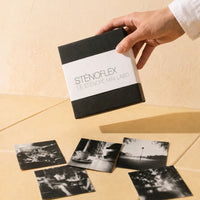
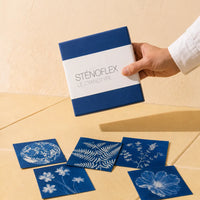
In workshop practice, each solution is made up with a powder measured out for a precise volume of water, which avoids the need for precision scales and calculation. The Sténoflex kit, for its part, provides the two solutions already diluted: one bottle of ferricyanide and one bottle of citrate, along with two pipettes for drawing up equal volumes without guesswork.
This one-to-one ratio is a proven balance, and it can be adjusted. You can shift it slightly to change the result: more ferricyanide tends towards a colder, more contrasty blue, more citrate towards a softer blue. But these variations are a matter of fine-tuning, and the starting point is always the equal-parts mixture.

Two volumes prepared separately before mixing. The concentrations and quantities are given in the instructions, not in this image.
Preparing each solution
For the quantities, the Royal Society of Chemistry formula specifies 5 g of potassium ferricyanide dissolved in 50 cm³ of water and, separately, 9 g of ferric ammonium citrate in 50 cm³ of water.
Each solution is prepared in ordinary room light, with no need for complete darkness, because as long as the two salts stay apart no image can form; it is their mixture that becomes sensitive, and you make it away from bright light. Wear gloves and work in a well-ventilated room, pour the powder into the water and not the other way round, and stir until it has completely dissolved.
The water matters. Demineralised water gives the most stable and consistent solutions, because the limescale and certain ions in tap water can cloud the bath or mark the paper with small spots. Failing that, tap water that is low in limescale is fine for getting started, but demineralised water is still the most reliable habit.
The temperature of the water helps too. Lukewarm water, never hot, dissolves the salts faster and more completely than cold water. Then leave the solution to stand for a few hours away from light before using it for the first time, so that it dissolves fully and any impurities settle.
In summary, to prepare the two solutions:
- 5 g of potassium ferricyanide;
- 9 g of ferric ammonium citrate;
- twice 50 cm³ of demineralised water, lukewarm rather than cold;
- two opaque or tinted bottles, one per solution;
- a small container for the day's mixture;
- two pipettes, for drawing up equal volumes;
- gloves, and a well-ventilated room.
Dilution and concentration
The concentration of the solutions is not set in stone: you choose it according to the result you are after and the surface you are printing on. Common recipes use a more concentrated ferric citrate solution than the ferricyanide solution, often in a ratio of around one to two, but balanced recipes with equal concentrations work very well and are simpler to measure out.
The Royal Society of Chemistry formula quoted above is one example, with 9 g of citrate to 5 g of ferricyanide in the same volume of water.
A more concentrated solution deposits more sensitive material on the paper and gives denser blues, at the risk of a grainy surface if you overload it. A more dilute solution produces lighter blues and subtler gradations, useful for delicate prints, but requires better-controlled exposure.
For a first recipe, the wisest course is to stick to the concentrations given by the kit or the instructions, then adjust once you have your own benchmark. Dilution is a lever you learn to use after a few prints, not a variable to explore from the very first sheet.
Mixing just before use
This is the central step of the recipe. You only mix the two solutions when you are about to sensitise the paper, in a small container, pouring in equal volumes of each. The mixture takes on a characteristic greenish-yellow tint, and it is this combined solution, and it alone, that is sensitive to UV light.
Once mixed, the solution slowly deteriorates and only keeps for a week, away from light and air. So prepare the amount needed for the day's work, no more, no less, allowing roughly enough to coat the sheets you have planned. A mixture kept beyond that loses sensitivity and can produce dull or fogged prints.
This combined solution, ready to use and applied while still wet, is what is sometimes called the wet method, as opposed to paper that is coated and then dried. It has its own particularities: it changes the way you expose and lay out the objects.
Once the solution is ready, all that remains is to apply it properly to the surface. Where the recipe ends, the paper takes over: coating with a brush or by soaking, choice of paper weight and drying.
Keeping the solutions separate
As long as they remain separate, the two iron solutions keep for a long time, several months and often longer, in opaque or tinted bottles stored away from light and in a cool place. It is precisely because they are kept apart that the process is so economical: you only mix the day's amount and the stock remains intact.
A few signs show that a solution has aged: persistent cloudiness, a sediment that will not redissolve, or a colour that has clearly drifted from the original. The ferric citrate solution is the more sensitive of the two: it can grow mould if the water or the bottle is not clean.
Handling the recipe with care
Both salts should be handled with caution, without any need for excessive worry. Wear gloves, work in a well-ventilated room, do not eat or drink nearby, and keep the powders and solutions out of reach of children.
According to the Royal Society of Chemistry data sheet, both salts irritate the skin and eyes, and ferricyanide also irritates the respiratory tract: safety glasses therefore complement the gloves.
For waste, collect the used baths, let the Prussian blue settle, filter out this sediment, and never pour this water into a garden, a pond or a watercourse.
The word ferricyanide sometimes frightens people, wrongly so. This salt is not free cyanide: its atoms are firmly bound to the iron, and it has low toxicity at the amounts used in the process, provided it never comes into contact with an acid.
Potassium ferricyanide can indeed release cyanide on contact with an acid, or under UV light when in solution: on contact with a strong acid it gives off hydrogen cyanide, which is highly toxic, and the Royal Society of Chemistry advises checking, when you dispose of the baths, that there is no acid already in the sink.
The Prussian blue formed at the end is so stable, incidentally, that it is used in medicine. This clarification, the protective measures and the treatment of rinse water are covered in more depth in the article on cyanotype safety.
From mixture to print
The recipe therefore comes down to very little: two iron solutions prepared separately, kept away from light, and combined in equal parts just before coating the paper. The rest depends on coating, exposure to the sun and rinsing, which turn this modest greenish-yellow solution into deep Prussian blue. When rinsing the print, the chemicals that stayed greenish under the objects wash away and only the blue remains on the paper.
To move from recipe to practice without tracking down each reagent separately or measuring by guesswork, the Sténoflex cyanotype kit brings together the two bottles of solution, the watercolour paper and the pipettes, with instructions.
Éric Marais — Photographer, author of two books on pinhole photography (published by Pearson) and creator of the Sténoflex. He has run introductory workshops in alternative photography, from pinhole to cyanotype, from the very beginning.