


You recognise a pinhole image almost without thinking, because it looks like no ordinary photo and carries something soft and distant within it. This very particular look is neither chance nor a defect: it comes directly from the absence of a lens, and this mix of signs is what is called the pinhole camera effect. Before looking at each feature closely, the pinhole guide lays the groundwork.
A soft blur that envelops the image
This page explains where the pinhole camera effect comes from, feature by feature: the softness, the depth of field, the vignetting and the trace of time.
The first feature that strikes you is this overall softness, the slight blur that softens every outline without ever muddling the reading of the image. Nothing is sharp-edged: everything seems drawn in pencil rather than cut with a razor.
This comes from the very nature of the process: with no lens to concentrate the rays, the pinhole lets the light in as it is, so no point of the scene is ever perfectly sharp. Diffraction plays its part too: passing through a very narrow opening, light spreads out slightly (in French), all the more so as the pinhole gets smaller, which means you cannot gain sharpness by shrinking the pinhole indefinitely. The full optical mechanics belong to how a pinhole camera works, but what matters here is that this softness is not a focusing defect: it is an even quality that gives the photo the feel of a memory rather than a record.

Why vignetting darkens the corners
Look at a pinhole photo and your eyes almost always slide towards the centre, drawn by a brightness that fades gently towards the edges. The corners are darker, sometimes markedly so, and this halo that closes in the image has a name: vignetting.
It comes from the geometry of the box, as the light reaching the corners arrives on the paper weaker than the light striking the centre. Far from being a nuisance, this vignetting is very much part of the charm of the look, since it focuses the gaze, frames the subject and gives the whole thing the air of an old photograph found at the bottom of a drawer.

An almost infinite depth of field
In a pinhole image, the blade of grass in the foreground and the hill on the horizon are rendered with the same approximation: neither is truly sharp, but neither is clearly blurred either. There is no plane of focus, and this is what is called an almost infinite depth of field, depth of field being the term for the zone of sharpness in an image.
Where a lens forces you to choose where to place the sharpness and pushes the rest into those melted backgrounds you see everywhere, the pinhole camera ignores that choice: everything is on the same plane, and the eye moves freely around the image without being told where to look. This equal treatment gives pinhole landscapes a strange presence, where near and far coexist in the same fabric.

Distortion and perspective in pinhole photography
Depending on the shape of the camera, the image can also show slight distortions, lines that curve, a perspective that stretches towards the edges, because a wide, shallow box gives a generous angle of view that exaggerates distances. These departures from the geometry of a conventional camera are not a mistake but a signature, and that is one of the reasons why no two pinhole cameras ever give quite the same image.
The angle of view depends on the distance between the pinhole and the paper: the closer the pinhole is to the paper, in a shallow box, the wider the angle, while a deep box tightens the framing.

The closer the pinhole is to the paper, the wider the angle and the more the perspective stretches towards the edges.
When long exposures leave motion trails
With no lens, a pinhole camera lets in little light and imposes exposure times counted in seconds, minutes, sometimes more, and this slowness transforms everything that moves. While the shutter stays open, the water of a river smooths into a silky sheet, the clouds stretch out, and a passer-by who does not stop ends up fading away like a ghost.
These are motion trails, the traces of movement recorded over the whole length of the exposure. The camera no longer records an instant but a slice of time, and this is probably the most poetic feature of the pinhole camera effect.

Grain, and why this look is sought after
On top of these features there is often visible grain, due to the paper used and its low sensitivity, so the image keeps a texture and a physical presence, far from the clinical smoothness of digital.

On paper, the pinhole image keeps a grain and a texture that digital has learnt to smooth away.
The digital pinhole filter does not fool anyone
Today you can find so-called pinhole filters in photo-editing apps, which add blur and dark corners to a phone photo in a single tap. From a distance, the result is reminiscent of the effect, but it does not stand up to scrutiny, because it only dresses up an image that is already sharp and already frozen in an instant.
The real process gives something else, because the softness lies in the light itself rather than being laid on top, the infinite depth of field comes from the absence of a lens, and above all the motion trails come from time that really passed in front of the box. The difference between the two worlds is detailed in pinhole photography on a digital camera.

The filter dresses up a frozen image; the pinhole camera records the time passing in front of the box.
See the effect with your own eyes
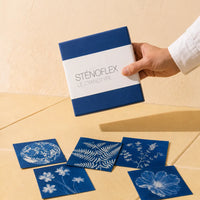
Nothing helps you understand this effect like producing it yourself, watching a soft, vignetted image streaked with motion trails appear in the developer bath. The Sténoflex kit, designed in France in 2009 for beginners, brings together the pinhole camera, the paper and the chemicals to get this look in a single session.
The pinhole camera effect cannot be reduced to blur or dark corners: it is the whole that makes the image, and it is by watching it come to life in your hands that you grasp why this look has never stopped moving people.

A pinhole print coming to life in the developer bath, under the red light of the darkroom: the softness and darkened corners appear along with the image.
Éric Marais — Photographer, author of two books on pinhole photography (published by Pearson) and creator of the Sténoflex. He has run introductory workshops in pinhole photography and analogue developing from the very beginning.