

You can take a photograph without a lens, with no glass at all, simply with a closed box with a tiny hole through which light enters to form an image at the back of the box.
In French, this hole is called a sténopé, and so is the box, because the word refers to both at once, which is often the first source of confusion when people discover the process.
The Greek origin of the word sténopé
The word comes from Greek, in which stenos means narrow and ope means hole, so that sténopé literally means the narrow hole. This vocabulary of ancient optics keeps coming up as soon as you start practising, and the pinhole photography glossary brings every term together with a simple definition.
In English, it is called a pinhole, the hole made by a pin, and the image is the same in both languages: an opening so small that it becomes an optical instrument.
This hole is far from a detail, because it is what makes the whole photo, its smallness playing the role of the lens in a conventional camera.
Pinhole: the hole and the camera
This point is worth clarifying straight away, because the French word sténopé has two meanings, both of them correct, which English separates into pinhole and pinhole camera.
The first meaning is the hole itself, the opening made in an opaque wall.
The second meaning is the whole camera, in other words the black box fitted with this hole that is used to take photographs, and you then speak of photographing with a pinhole camera, or of owning one.

The pinhole camera, heir to the camera obscura
The pinhole camera is not a recent invention, because it descends directly from the camera obscura, a Latin expression meaning dark chamber. So nobody invented it, strictly speaking: its principle was described as early as Antiquity by Mozi in China and by Aristotle, then analysed by Ibn al-Haytham around the year 1000, and the first pinhole photographs are credited to the Scottish physicist David Brewster, around 1850.
The photographic pinhole camera uses this same dark chamber scaled down to the size of a box, the difference coming from one addition: a light-sensitive surface is placed at the back, so that the projected image is no longer just looked at but recorded.

The inverted, soft image of the pinhole camera
What you get is a real photograph, not just an effect or an optical curiosity that goes nowhere: an image fixed on paper or film that you can hold in your hands.
This image has two recognisable features.
It is inverted, with the top ending up at the bottom and left switching to right, a reversal that comes from the path of light inside the box and belongs to the whole way a pinhole camera works.
It is also soft, because without a lens to concentrate the light, a pinhole camera does not give the crisp sharpness of a lens and leaves outlines softened, almost drawn in pencil, which many people regard as its charm rather than a flaw. Everything looks equally sharp, from the foreground to the horizon, with an almost infinite depth of field.

The pinhole camera: a very simple photographic process
The pinhole camera is one of the oldest and simplest photographic processes, and understanding this word means holding the thread of all photography.
A box, a hole, light and a sensitive surface are enough, while everything else, lenses, sensors and automatic functions, is only a refinement of this first gesture. Making one yourself takes only four things:
- an opaque box blackened inside;
- a needle hole pricked in a thin sheet of aluminium;
- a flap of black tape as a shutter;
- a sheet of photo paper.
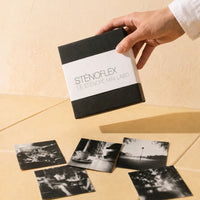
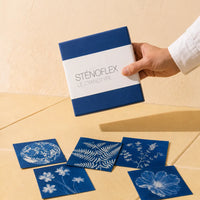
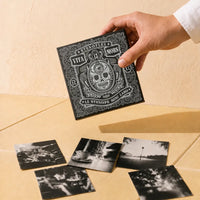
To try it for yourself, the Sténoflex contains everything you need, from taking the picture to developing it.
This simplicity comes at a price: slowness. The hole lets very little light through and photo paper has low sensitivity, around 3 to 6 ISO, so the exposure lasts from a few seconds in full sun to several minutes near a window.
You understand this process better by seeing how this tiny hole manages to draw a sharp image, which is the whole working of the pinhole camera and the mechanics of light that go with it.

A blackened box, a needle hole, a flap of tape and a sheet of photo paper are all you need.
Éric Marais — Photographer, author of two books on pinhole photography (published by Pearson) and creator of the Sténoflex. He has run introductory workshops in pinhole photography and analogue developing from the very beginning.