

Cyanotype needs two chemicals, ferric ammonium citrate and potassium ferricyanide, dissolved in distilled water, plus two opaque bottles, a brush without a metal ferrule and two pipettes. Cyanotype relies on remarkably pared-back chemistry.
Two iron salts are enough to form the image, and everything else comes down to a few consumables that are easy to find. Before talking about measuring and mixing, it is worth drawing up a complete inventory of what you need to gather and knowing where to get it, because the quality of the reagents and the water matters as much as the precision of your technique.
This page focuses on the list of products and how to buy them. How to combine them, the proportions and the dilution come with the recipe, which takes over once you have gathered your supplies. The complete cyanotype guide lays the groundwork.
The two essential iron salts
At the heart of the process are two powders, and only two. Ferric ammonium citrate, a greenish-brown powder that provides the light-sensitive iron, and potassium ferricyanide, red-orange crystals that will react with this iron to produce the blue. Kept separate and protected from light, these two substances keep for a long time. Take care not to confuse ferricyanide with potassium ferrocyanide, a yellow salt that does not produce a cyanotype.
It is when they meet, under ultraviolet light, that insoluble Prussian blue forms. Potassium ferricyanide has low toxicity at the amounts used in the process, but it can release cyanide on contact with an acid, or under UV light when in solution, so you never acidify it.
These salts come in two forms. Powder is the cheaper form and the more stable in storage, but it means preparing the solutions yourself by weighing or dissolving in water.
Ready-mixed solution, sold ready to coat, saves you this step at the cost of a shorter shelf life once the two components are combined. For regular practice, powdered chemicals that you dissolve offer a good balance between cost, shelf life and control over the result.
Modest quantities
The quantities you need are modest. A few tens of grams of each salt are already enough to prepare half a litre of each solution, enough to sensitise a large number of sheets. There is no need to think big at the start: these reagents last, and a small pack is more than enough for your first attempts.

The two cyanotype reagents, in a photograph from the Sténoflex image library. Cropped from the original image; the labels are shown as photographed, unchanged.
Why use distilled water
Water is used at two stages: to dissolve the powders and to rinse the print. For dissolving, distilled or demineralised water is better than tap water, because the limescale and metal ions in some hard water can cloud the solution or mark the paper with pale spots. Pure water ensures a clean reaction and an even blue background.
Distilled water can be found for next to nothing in supermarkets, in the ironing aisle, in DIY stores or at the pharmacy. The final rinse, on the other hand, copes well with tap water in most areas; the need for purity mainly concerns preparing the solutions.
Containers and the coating tool
Around the salts, a few accessories complete the inventory. First you need something to store the two solutions in: two opaque bottles or tinted ones, in amber glass or dark plastic, because light slowly degrades ferric citrate. A neutral container, glass or plastic, is then used to mix the two solutions in equal parts at the time of use.
To spread the sensitiser on the paper, the most common tool is a wide, soft-bristled brush, preferably without a metal ferrule, because metal can react with iron salts. A glass rod or a foam applicator also works for a very even coat. Many studios keep a brush for this use alone, to avoid any contamination.
Finally, measuring calls for a little precision. Two graduated pipettes, one per solution so as not to mix them up, are enough to draw up equal volumes. Kitchen scales accurate to the gram come in handy if you are starting from pure powder and preparing your solutions yourself.
To gather the containers and accessories:
- Two opaque or tinted bottles to store the solutions separately.
- A glass or plastic container for mixing.
- A soft brush without a metal ferrule, a glass rod or a foam applicator.
- Two graduated pipettes, one per solution.
- Scales accurate to the gram if you are preparing the solutions from the pure salts.
Where to buy cyanotype chemicals
You will not find the two iron salts in a supermarket, but several channels sell them. Chemical suppliers and laboratory suppliers sell them by weight, often in packs designed for professional use, larger than a beginner needs.
Specialist alternative photography shops and fine art shops offer packs suited to artistic practice, sometimes with instructions. Buying online is still the most convenient way to get both salts in one go.
Buying separately suits those who want to control their quantities and replace a single reagent over time. On the other hand, it means measuring everything out yourself, getting hold of containers and checking the quality of the powders. This is familiar ground for experienced practitioners, less obvious for a first print.
For a first go, starting from a set that has already been put together makes things simpler.
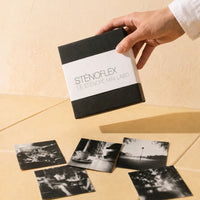
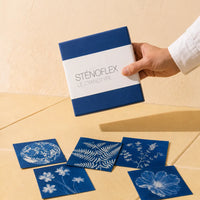
The Sténoflex cyanotype kit brings together potassium ferricyanide and ferric ammonium citrate, ten sheets of watercolour paper, two pipettes and instructions. This spares you tracking down each reagent one by one and working out the starting proportions.
However you buy them, the chemical supplies are only half of the equation. The surface you print on matters just as much, and choosing paper for cyanotype deserves the same attention as choosing the salts.
Once you have the products, the cyanotype recipe goes through measuring, mixing and coating step by step. The same products can be used to sensitise cotton or linen fabric, as the chemistry stays the same on textiles.
Éric Marais — Photographer, author of two books on pinhole photography (published by Pearson) and creator of the Sténoflex. He has run introductory workshops in alternative photography, from pinhole to cyanotype, from the very beginning.